
Heat Recovery Wheels
Recover Up to 85% of Exhaust Energy and Reduce HVAC Operating Costs
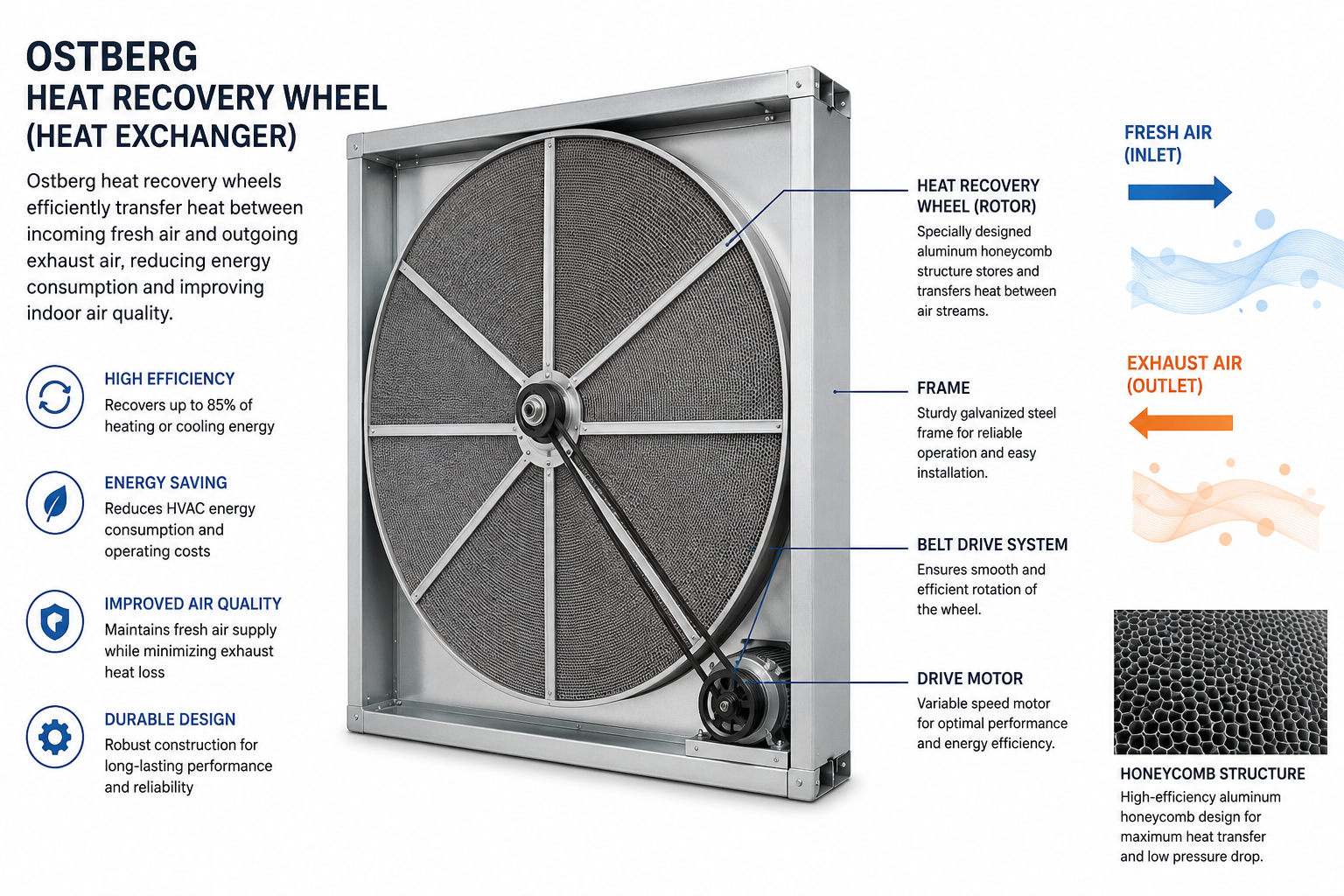
Why Choose Heat Recovery wheels
Designed and manufactured in Sweden, Ostberg Heat Recovery Wheels deliver exceptional energy recovery performance by transferring heat between exhaust and incoming fresh air streams. Improve indoor air quality, lower energy consumption, and achieve sustainable building performance with advanced rotary heat exchanger technology.
Designed and manufactured in Sweden, Ostberg Heat Recovery Wheels deliver exceptional energy recovery performance by transferring heat between exhaust and incoming fresh air streams. Improve indoor air quality, lower energy consumption, and achieve sustainable building performance with advanced rotary heat exchanger technology.
✓ Swedish Engineering
✓ Up to 85% Efficiency
✓ LEED & ASHRAE Compliant Solutions
✓ Custom Sizes up to 5000 mm Diameter
We Follow Best Practices
Backed by decades of expertise and trusted partnerships, GESS combines cutting-edge technology and engineering excellence to pave the way for a more sustainable future.
- Energy Saving
- Better Indoor Quality
- Frost Resistant
- Self Cleansing
Request a Quote
Learn More From
Frequently Asked Questions
The Östberg rotary heat exchanger operates on a regenerative air-to-air principle. It features a rotating wheel constructed from alternating corrugated and smooth aluminum foils that slowly turns between two opposing air streams—the warm exhaust air and the cooler incoming fresh air.
In winter: The exhaust air warms the aluminum matrix, which then rotates to preheat the cold incoming outdoor air.
In summer: The process reverses to pre-cool the fresh supply air using conditioned exhaust air. Depending on the specific rotor matrix type chosen, it can transfer sensible heat only or both sensible and latent heat (moisture).
Östberg offers different rotor media options tailored to specific climate and humidity control needs:
Sensible (Condensation) Wheels: Made of untreated high-quality aluminum foil, ideal for dry applications where only thermal energy (temperature) transfer is required.
Enthalpy / Hybrid Wheels: Designed to transfer both heat and moisture, helping maintain indoor humidity levels.
Sorption Wheels (Molecular Sieve): Features specialized coatings (like 3Å molecular sieves) optimized for high-performance moisture adsorption, making them exceptional for humid climates or specialized spaces like swimming pools and commercial facilities.
The Östberg Double Wheel Concept is an advanced configuration utilizing two rotary wheels in series (often combining moisture and thermal control) to maximize efficiency. This setup can save up to 60% of total cooling capacity, eliminate the need for traditional post-reheating, and drastically lower both initial capital investment and long-term running costs for HVAC systems.
Östberg wheels are designed for longevity and minimal upkeep, but routine checks ensure optimal performance:
Drive Belt: The peripheral drive belt should be periodically inspected and adjusted according to the maintenance schedule.
Seals: The brush seals (which minimize air leakage between streams) should be checked for wear.
Cleaning: Depending on the indoor environment and filtration quality, the rotor matrix can be gently cleaned of accumulated dust using compressed air or a soft brush to maintain clear airflow channels and low pressure drops.
Östberg heat recovery wheels can recycle more than 85% of the energy from conditioned building exhaust or high-temperature industrial exhaust processes.
Implementing these air-to-air energy exchangers helps buildings achieve higher LEED status and easily meet the compliance requirements of ASHRAE 90.1.
Casings are available across a wide product range spanning from $\emptyset300\text{ mm}$ up to $\emptyset5000\text{ mm}$.
Standard casings are built from galvanized sheet steel, with optional powder coatings available for enhanced corrosion protection.
Certain models (such as DS and D units from $\emptyset2451\text{ mm}$ to $\emptyset4250\text{ mm}$) feature aluminum profile frames, while larger units utilize heavy-duty steel profile frames.
Purge sectors can be supplied for all casings in optional fixed sizes of $2.5^{\circ}$, $5^{\circ}$, $10^{\circ}$, or as adjustable $0^{\circ}-5^{\circ}$ configurations.
They are selected based on the specific pressure conditions of the unit to effectively prevent carryover of exhaust air into the fresh supply airstream.
Purge sectors can be supplied for all casings in optional fixed sizes of $2.5^{\circ}$, $5^{\circ}$, $10^{\circ}$, or as adjustable $0^{\circ}-5^{\circ}$ configurations.
They are selected based on the specific pressure conditions of the unit to effectively prevent carryover of exhaust air into the fresh supply airstream.