
Case Study: High-Capacity Dehumidification for Aquatic Arenas
Project: Dubai Dolphinarium (Creek Park)
Location: Dubai, United Arab Emirates
Focus: Management of Massive Latent Loads & Indoor Air Quality (IAQ)
1. The Challenge: An Indoor Tropical Microclimate
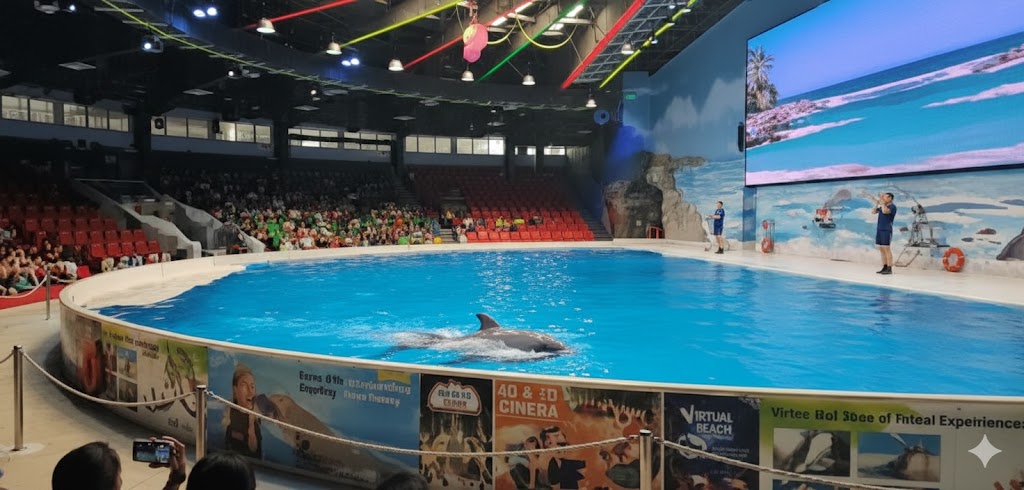
The Dubai Dolphinarium houses over 1.5 million gallons of seawater within a fully enclosed, 5,000-square-meter climate-controlled arena. This creates an unprecedented HVAC challenge:
- Massive Evaporation Rates: The large surface area of the pools, combined with splashing during performances, releases a constant stream of moisture into the air.
- Chlorine & Saline Corrosion: The indoor air is heavily laden with salt and pool chemicals (chloramines), which are highly corrosive to standard metal ductwork and cooling coils.
- Thermal Shock & Condensation: The temperature difference between the cooled spectator seating and the humid pool air can lead to condensation on the roof and structural glass, causing “indoor rain” and structural degradation.
- Occupant Comfort vs. Animal Welfare: The system must balance the cooling needs of 1,200 spectators with the specific environmental requirements of the marine mammals.
2. The Solution: Industrial-Grade Dehumidification & Protection
Managing this environment requires a heavy-duty industrial approach to air treatment, utilizing high-specification SKM Tropicalized Units with specialized coatings.
A. Dedicated Pool Dehumidification Units (PDU)
Unlike standard AHUs, the arena utilizes PDUs designed specifically for aquatic centers. These units operate on a reheat cycle: air is cooled below the dew point to strip moisture and is then reheated using “free” heat recovered from the compressor to return the air to the arena at a comfortable temperature and low humidity.
B. Marine-Grade Corrosion Armor
Every component of the HVAC system is “hardened” against the saline environment:
- Coils: Electro-finned or epoxy-coated (Blygold) copper coils to prevent pitting and leaks.
- Casing: Double-skin panels with high-grade stainless steel or powder-coated aluminum to resist rust.
- Ductwork: Often utilizing fabric ducting or specialized PVC-coated steel to prevent corrosion from the high-chlorine air.
C. Stratification & Airflow Management
The system uses high-velocity jet nozzles to create an “air curtain” over the pool surface. This contains the humid air at the water level and prevents it from migrating into the spectator seating areas, allowing for more efficient zone-based dehumidification.
3. The Results: Crystal Clear Visibility & Structural Safety
- Visibility: By maintaining the humidity below 55% RH, the facility prevents fogging on glass enclosures and the large LED screens, ensuring an unobstructed view for the audience.
- Structural Preservation: The elimination of condensation on the steel roof trusses prevents long-term oxidation and significantly reduces maintenance costs.
- Health & Safety: Proper air turnover rates remove “pool odors” (chloramines) from the air, ensuring a fresh and healthy environment for both children and the dolphins.
4. Technical Specification Summary
| Feature | Implementation Detail |
| System Type | DX or Chilled Water with Hot Gas Reheat |
| Coating | Marine-grade C5-M / Epoxy Coated Coils |
| Humidity Target | 50% – 55% RH (Strictly Controlled) |
| Air Distribution | Anti-corrosive Jet Diffusers & Fabric Ducts |
| Key Technology | Heat Recovery for Dehumidification Reheat |
Conclusion: The Dubai Dolphinarium is a prime example of engineering for extreme latent loads. By integrating corrosion-resistant materials with advanced moisture-stripping technology, the facility maintains a world-class entertainment environment in the heart of the desert.