
Fabric Ducts
Transforming Buildings Into Healthier Spaces
European-manufactured fabric ducts delivering draft-free comfort with a strong focus on sustainability, supreme hygiene, and effortless installation.
Transforming buildings into healthier and more comfortable spaces
Danish quality, sustainable engineering, and draft-free air distribution systems designed to match your design intent.
- Draft-free comfort
- Fast installation
- Extremely lightweight
- 100% hygienically clean
- No condensation or insulation
- Fully customizable
Why Euro Air Fabric Ducts?
Key Features
Euro Air provides advanced, European-engineered textile ducting systems crafted in Denmark since 1991. Designed for modern commercial, industrial, and public spaces, Euro Air delivers draft-free air distribution, superior indoor comfort, and maximum energy efficiency without compromising on design intent.
- Draft-Free Indoor Comfort: Provides even, gentle air distribution along the entire system length. Eliminates dead zones, drafty drafts, and cold spots for optimal occupant comfort.
- Rapid & Lightweight Installation: Weighs only 260–330 g/m² and packs down under 25 kg. Installs up to 70% faster than traditional metal ductwork using simple hand tools.
- Hygienic & Condensation-Free: Breathable fabric construction naturally prevents moisture condensation without extra insulation. Easily removable and 100% washable to keep systems free of dust and impurities.
- Sustainable Danish Engineering: Manufactured exclusively in Europe with Cradle-to-Cradle certification. Complete control from yarn to final solution ensures long-lasting, eco-friendly performance.
Request a Quote
Learn More From
Frequently Asked Questions
Euro Air fabric ducts are a smart, lightweight alternative manufactured in Denmark since 1991. They provide even, draft-free air distribution, install up to 70% faster than metal, weigh only 260–330 g/sq.m, and are 100% hygienically washable.
No. The breathable material naturally prevents moisture condensation, eliminating the need for extra insulation in standard operating conditions.
They are extremely lightweight (packaging is under 25 kg) and can be easily installed by two people without complex tools—often up to 70% faster than traditional metal ducting.
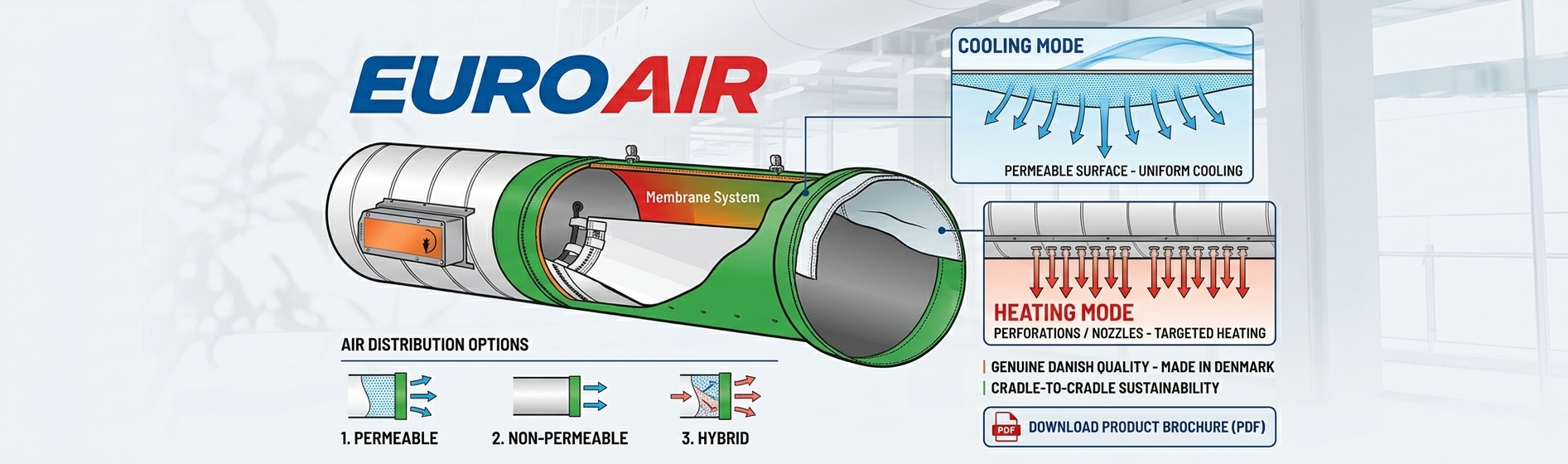
Permeable systems allow air to flow gently through the entire fabric surface using passive temperature-driven movement, making them ideal for cooling and fresh air supply without drafts.
Non-permeable systems supply air exclusively through precise perforations (DFC) or nozzles, allowing for targeted airflow, higher velocities, and heating or cooling in high-ceiling spaces.
A hybrid system combines both approaches—uniform passive air supply through the permeable fabric and targeted active airflow through perforations or nozzles—making it versatile for spaces like offices, classrooms, and commercial kitchens.
The membrane system integrates both functions into a single duct separated by an airtight layer. It switches automatically: cooling air is distributed through the upper half, while heating air exits through the lower perforated surface.