
Air Curtains
Keep conditioned air in and unwanted dust, heat, insects, and outdoor air out. Our Wing Air Curtains provide powerful, efficient airflow to create an invisible barrier at entrances—helping maintain indoor comfort while reducing energy loss.
Wings: Air Curtains
WING is a European manufacturer founded in 1989 in Poland, specializing in technically advanced HVAC equipment.
The WING air curtain creates an invisible thermal barrier separating environments with different air parameters.
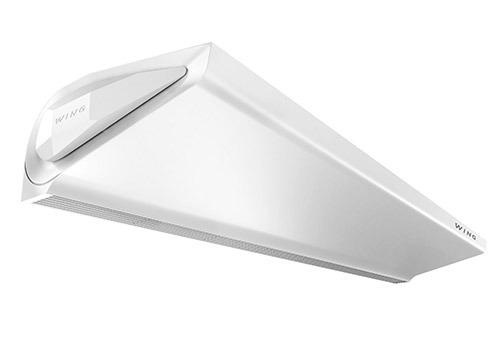
Inspired by glider wings, the minimalist housing features characteristic diamond-shaped side covers for unique elegance, combining an energy-saving motor with an efficient fan for quiet, high-efficiency operation.
- Minimalist & Aerodynamics
- Silence & Power
- High Performance
Why Wing Air Curtains?
Key Features
Wing Air Curtains provide an effective air barrier over open doorways, helping maintain indoor comfort while reducing the entry of dust, hot air, insects and outdoor pollutants. Designed for commercial and industrial applications, they support energy-efficient climate control without restricting access through frequently used entrances.
-
Flexible Mounting: WING air curtains can be mounted either horizontally or vertically.
-
Space-Saving Design: Due to the slim profile, low casing height, and inclined air inlet, units can be installed in tight spaces above doors without impacting performance.
- Available Sizes: Offered in multiple dimensions to fit various architectural requirements, including 100 cm, 150 cm, and 200 cm widths.
Request a Quote
Learn More From
Frequently Asked Questions
A Wing Air Curtain is an air barrier installed above an entrance to create a high-velocity stream of air across the doorway. It helps reduce the exchange of indoor and outdoor air while allowing doors to remain open.
Air curtains can help maintain indoor comfort, reduce the entry of dust and insects, limit conditioned-air loss, and improve energy efficiency in commercial and industrial spaces.
They are suitable for shopping malls, retail stores, hotels, restaurants, offices, warehouses, factories, supermarkets, hospitals and other buildings with frequently opened entrances.
Yes. Air curtains are commonly used alongside air-conditioning systems. They help reduce the uncontrolled movement of outdoor air through open doorways, supporting more consistent indoor temperatures.
Selection depends on factors such as door width, door height, installation location, required airflow, operating conditions and whether heating or cooling is required. A technical assessment is recommended to select the appropriate model.